






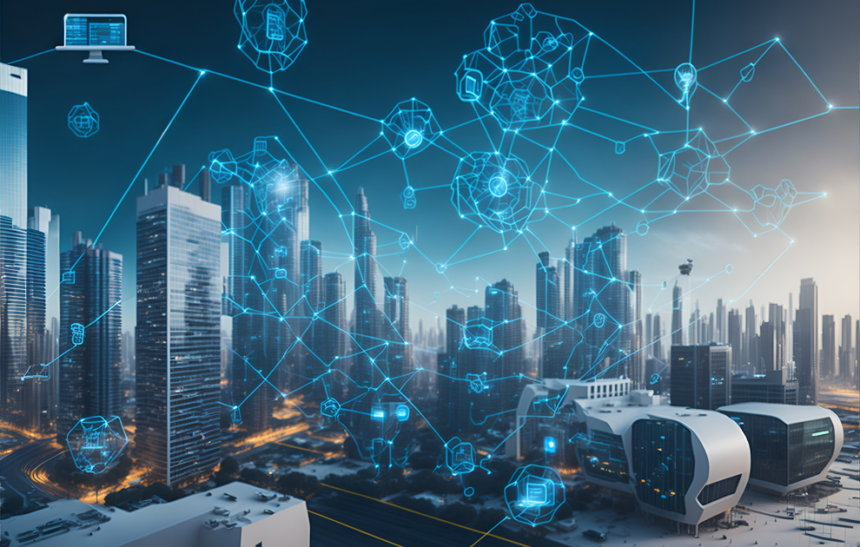
Imagine being able to see a city change before the city actually changes.
A new housing development appears on a digital model.
Traffic flows through it. Energy demand rises in one district and falls in another. A summer heatwave moves across the neighbourhood. Electric vehicles begin charging after work. A new bus route alters pedestrian movement.
A flood reaches one intersection but not another. Planners can alter the buildings, roads, transport routes or drainage systems and watch the consequences unfold again.

This is where the smart city conversation is quietly moving. The important development is no longer simply that cities can collect more data. They are beginning to acquire the ability to experiment with that data.
That distinction matters. For much of the smart city era, technology was primarily used to observe urban life. Sensors counted vehicles. Cameras monitored streets. Platforms displayed energy consumption. Command centres brought information from different departments onto screens. Useful as these systems were, the city remained largely reactive.
The emerging model is different. Artificial intelligence, digital twins, geospatial systems, connected infrastructure and increasingly autonomous machines are allowing urban systems to become more predictive and interactive. International technology and urban development bodies are now explicitly discussing the transition from smart cities toward more autonomous cities, in which urban environments can sense, learn, predict and increasingly coordinate responses.
From Seeing the City to Testing the City
The most interesting shift may be happening inside the digital twin.
A conventional model can show what a city looks like. A more capable urban digital twin can begin to represent how the city behaves. That means connecting buildings, roads, utilities, transport, environmental conditions, infrastructure and human activity into a living computational representation.
The difference sounds technical, but its consequences are deeply human.
Consider a simple decision such as where to place a new transport interchange. Traditionally, planners work from historical traffic data, demographic projections, engineering studies and experience. A sophisticated urban simulation can add another layer: it can test multiple versions of the decision against one another before construction begins.
The same principle can apply to flood protection, electric vehicle charging, public transport, energy systems, housing, waste collection and emergency planning.
Recent research is already exploring digital twins that connect artificial intelligence with infrastructure such as residential electric vehicle charging, while newer work on urban mobility is examining how multiple digital twins might work together rather than operating as isolated models.
This changes the commercial opportunity for smart city companies.
The valuable capability may no longer be simply installing sensors or producing a dashboard. It may be helping a city answer a much more consequential question: “If we do this, what happens next?”
The City Becomes an Experiment
There is something almost scientific about this new model of urban development.
A city can begin to test hypotheses.
What happens if this road becomes pedestrian-only? What happens if thousands of vehicles charge between certain hours? What happens if a neighbourhood gains more trees but fewer parking spaces? What happens if a new residential district is built around public transport rather than private cars? What happens during an extreme rainfall event? What happens when an ageing piece of infrastructure fails?
Historically, many of these questions could only be answered after a physical intervention. That made urban development expensive, slow and difficult to reverse.
Simulation changes the economics of learning.
It does not eliminate uncertainty. A model can never reproduce every human decision, political constraint, unexpected event or physical interaction. But it can make some uncertainty visible earlier, when changing the plan is still relatively cheap.
That may become one of the most important functions of smart city technology.
The smart city of the previous generation often promised efficiency. The emerging city may offer something more valuable: better decisions.
This is also why the technology is expanding beyond the traditional boundaries of urban IT. Geospatial companies, infrastructure specialists, artificial intelligence developers, mobility platforms, engineering firms, cloud providers, robotics companies and energy technology businesses can all occupy different parts of the same emerging urban system.
There may not be one “smart city platform” in the future. Instead, cities could become ecosystems of interconnected models, data systems and operational technologies.

From Projects to Urban Operating Capability
This creates a subtle challenge for the companies building the technology.
A city does not need another isolated technology project simply because the technology is impressive.
It needs systems that can work across departments, infrastructure and time.
A digital twin that sits inside one planning department may be useful. A digital twin that can connect planning with transport, utilities, climate resilience and infrastructure management becomes something different. It begins to resemble an operating layer for the city itself.
This is one reason interoperability has become such an important part of the conversation. Urban technology increasingly has to work with systems that were not designed together and may have been installed years apart. The challenge is not merely collecting more information. It is allowing different kinds of information to become useful together.
Recent guidance on AI-enabled urban environments places considerable emphasis on interoperability, governance, cybersecurity, human oversight and data sovereignty alongside the technology itself. That is an important signal about where the market is maturing. The difficult part of building an intelligent city is increasingly not proving that a technology works in isolation. It is making the technology work inside a complicated living institution.
This may favour a different kind of smart city company.
The strongest organisations may not necessarily be those with the most visible hardware. They may be the ones capable of connecting fragmented systems, translating complex information into decisions, integrating with existing infrastructure and staying useful after the original project has been completed.
That creates an unusually broad field for innovation. A company working in mobility can become part of urban planning. An energy technology company can become part of city resilience. A geospatial company can become part of emergency management. An AI company can become part of infrastructure operations.
The boundaries between industries begin to soften because the city itself is the common system.
The Most Important Interface May Still Be Human
There is another development worth watching.
As cities become more computationally capable, the technology has to become easier for ordinary people to understand.
A planner may want a simulation. A mayor may want to compare scenarios. An engineer may need precise infrastructure data. A resident may simply want to know what a proposed development will look like from their street.
The same underlying urban intelligence can serve all four.
This matters because public acceptance is not a technical problem alone. People are more likely to engage with change when they can see it, question it and understand its consequences.
Recent urban redevelopment work illustrates how digital twins, spatial mapping and AI-assisted communication are increasingly being used not only for planning but also to help communities visualise and understand proposed changes. The technology becomes a communication layer between institutions and citizens, not merely an internal management tool.
That could become one of the less obvious markets around intelligent cities.
The next generation of urban technology may need to translate between machines and people just as much as between one database and another.
What a Smarter City Is Really Buying
It is tempting to describe this movement as another chapter in the technology industry’s long fascination with making cities “smart”. But that misses the deeper change.
A city is not a machine waiting to be optimised.
It is a living arrangement of people, buildings, businesses, institutions, infrastructure, habits and aspirations. Its most important outcomes cannot always be reduced to speed, efficiency or cost.
A successful transport system can save time, but it can also change who can reach opportunity. Better energy management can reduce waste, but it can also influence affordability and resilience. More intelligent planning can improve infrastructure, but it can also determine whether a neighbourhood feels connected or isolated.
This is why the next generation of smart city companies may ultimately be judged by something larger than technological sophistication.
Can they help cities make better choices?
Can they help institutions see consequences before committing resources? Can they make complex urban systems understandable? Can they connect previously separated pieces of infrastructure? Can they improve resilience without making everyday life feel more controlled? Can they help cities experiment without treating citizens as experiments?
These questions turn smart city technology into something much more interesting than a collection of sensors, platforms and command centres.
They turn it into an emerging capability for civilisation itself: the ability to learn about a place before changing it.
Perhaps that is the real transition now underway.
The smartest city may not be the one with the most technology visible on its streets. It may be the one that has quietly learned to think through its choices before asking millions of people to live with them.